One of the simplest yet most life-changing phrases in all of Scripture is only two words long: “in Christ.”
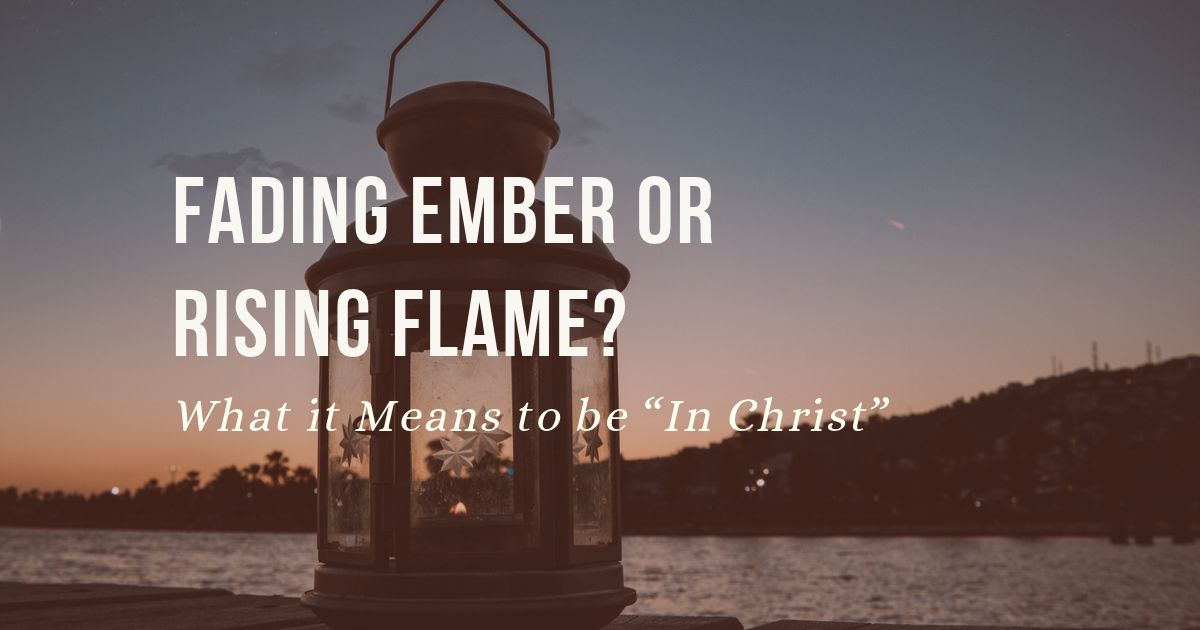
Imagine taking a glowing ember out of a campfire and laying it by itself on a cold rock. At first, it still glows independently with warmth and light. But within a few minutes, the glow fades, the heat cools, and the ember becomes lifeless. Place that same ember back into the fire, however, and it once again burns brightly because it is surrounded by the source of its life and heat.
That simple picture illustrates one of the Apostle Paul's favorite ways of describing the Christian life. The believer's hope, identity, security, and usefulness are never found in himself. They are found because he is “in Christ.”
Paul uses this expression over 80 times throughout his letters, and that repetition is no accident. Being "in Christ" is not merely a poetic expression or a comforting metaphor. It describes the believer's union with the risen Lord. At the moment of salvation, God graciously places every believer into Christ, identifying him forever with His Son. Because of that union, everything that belongs to Christ becomes the believer's by grace. This truth is so rich for the believer in numerous ways! Let me give four.
This truth transforms the way we think about salvation.
We are not accepted because we have earned God's favor. We are accepted because we are in the One who perfectly pleased the Father. We are not declared righteous because we have lived righteous lives. We are declared righteous because we are in Christ. Paul writes, "Therefore there is now no condemnation for those who are in Christ Jesus" (Rom. 8:1). Our standing before God rests securely on Christ's finished work on the cross rather than our fluctuating performance.
This truth transforms our identity.
Our culture constantly encourages people to define themselves by their accomplishments, failures, careers, personalities, or past experiences. Scripture points us somewhere entirely different. The most important thing about a Christian is not what he has done, but where he is. He is in Christ. That means he is a new creation (2 Cor. 5:17). He has been blessed with every spiritual blessing (Eph. 1:3). He has been chosen, redeemed, forgiven, and given an eternal inheritance. These are not goals we strive to attain; they are blessings we already possess because of our union with Christ.
This truth changes the way we live.
Paul never presents this doctrine as an excuse for spiritual complacency. Instead, it becomes the strongest motivation for holy living. Because we have died with Christ to sin and have been raised with Him to new life, we are called to walk in a manner worthy of that new identity. We do not pursue obedience in order to become God's children. We obey because we already belong to Him. Christian growth is not an attempt to earn acceptance; it is learning to live consistently with who we already are in Christ.
This truth strengthens us in the painful moments.
Trials may shake our circumstances, but they cannot alter our position in Christ. Failures may humble us, but they cannot remove us from Christ. Even death itself cannot separate believers from the Savior to whom they are united. Our security rests not in the strength of our grip on Him, but in the permanence of His gracious hold on us.
As we gather for this year’s Steadfast Bible Conference, my prayer is that each of us will look beyond the familiar phrase "in Christ" and rediscover the breathtaking reality behind it. The Christian life is not fundamentally about trying harder or becoming more religious. It is about understanding, believing, and living out all that God has already accomplished for us through our union with His Son.
Remember the ember beside the fire?
The ember has no lasting warmth in itself. Its life, light, and usefulness are found only as it remains in the fire. In a far greater way, every spiritual blessing we enjoy flows from our relationship with Jesus Christ. Our hope is not found in ourselves but in Him. Our strength is not our own but His. Our confidence is not rooted in what we have accomplished, but in what He has accomplished on our behalf.
The greatest privilege of the Christian life is not simply knowing about Christ. It is being forever “in Christ.”